
ANALYTICAL SCIENCES
CASE STUDY
Background
In pharmaceutical manufacturing, surface energy governs how powders behave. It influences interparticle adhesion, flow, caking tendency, and ultimately processability, making it a critical but often undercharacterised material attribute.
When particle size is reduced through milling, the conventional expectation is straightforward: smaller particles, greater surface area, higher surface energy. But the reality is more nuanced, and for formulation scientists, that nuance matters.
This study examined three sucrose fractions produced by two different processing routes to investigate whether particle size alone drives surface energy changes, or whether the method of size reduction plays an independent role.
The Challenge
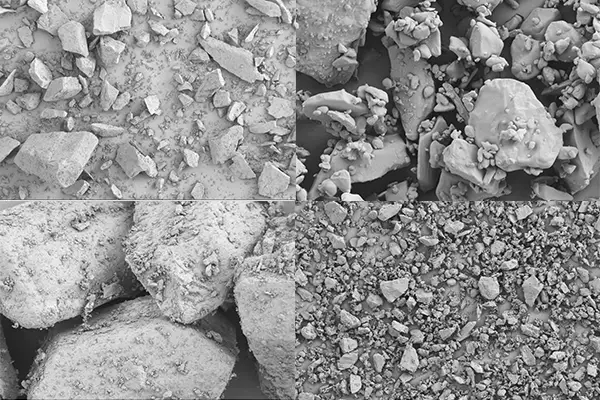
The development team needed to understand how processing-induced changes to sucrose surfaces would affect downstream formulation behaviour. Three sucrose samples were produced: a Coarse fraction (500–180 μm) and a Medium fraction (150–45 μm) obtained by pestle-and-mortar grinding and sieving of granulated sucrose, and a Fine fraction (45–30 μm) obtained by sieving of industrially milled sucrose.
The key questions were:
- Does surface energy increase predictably with decreasing particle size across all fractions?
- Does the milling method introduce surface changes beyond particle size reduction alone?
- What do those changes mean for interparticle adhesion, blend homogeneity, and compactability in a pharmaceutical context?
Without quantitative surface energy data, these questions could not be answered from particle size analysis alone.
Our Approach
Resolian’s analytical team applied a multi-technique characterisation strategy to build a complete picture of each fraction’s surface.
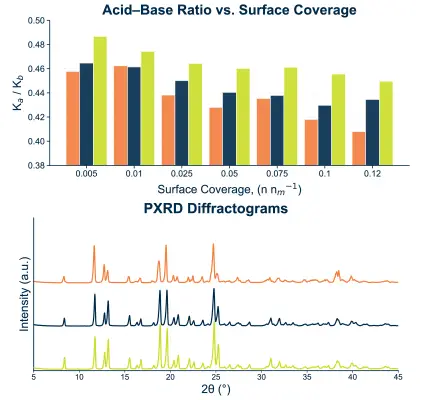
Scanning electron microscopy (SEM) was used to assess particle morphology and surface texture across the three fractions. Powder X-ray diffraction (PXRD) confirmed crystalline phase consistency. BET specific surface area (SSA) was determined by nitrogen gas adsorption.
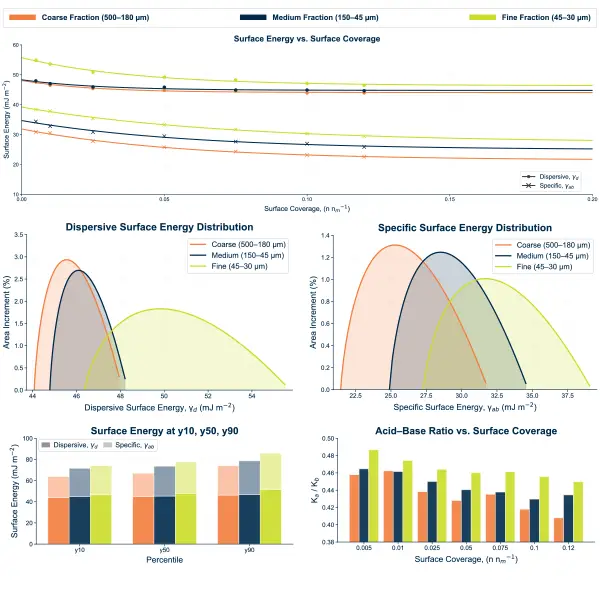
Surface energy analysis was conducted using iGC-SEA. Sucrose samples were packed into silanised glass columns to a total surface area of approximately 0.5 m² and conditioned at 30°C for 60 minutes under helium carrier gas. Dispersive and specific surface energy heterogeneity profiles were determined using the Dorris-Gray methodology and Peak COM parameter across a range of fractional surface coverages.
Results
BET SSA was expected to increase with decreasing particle size. The Coarse and Medium fractions followed this trend, but the Fine fraction deviated, with a lower SSA than expected. SEM imaging revealed differences in surface texture and a reduced level of adhered fine particles on larger surfaces in the Fine fraction, pointing to a significant effect of industrial milling on surface morphology beyond size reduction alone. PXRD confirmed the crystalline phase was consistent across fractions, though baseline characteristics of the Fine fraction suggested a possible increased amorphous contribution from the industrial milling process.
Surface energy analysis told a clear story. Hand grinding produced comparable dispersive surface energy values across the Coarse and Medium granulated fractions, while having a more pronounced effect on specific surface energy. The commercially milled Fine fraction exhibited noticeably higher surface energies and greater heterogeneity across both dispersive and specific components. This points to processing route, not particle size fraction, as the dominant influence on dispersive surface energy.
Acid-base probe analysis showed greater basic character across all samples, consistent with a higher concentration of electron-donating functional groups on sucrose surfaces. A decrease in Ka/Kb ratio with increasing surface coverage indicated that this basic character is most pronounced at lower-energy surface sites.
What This Means
Particle size reduction influences both dispersive and specific surface energies of sucrose, but the processing route has a greater impact than size fraction alone.
The absence of a direct trend between BET SSA and surface energy values underlines the limitation of relying on particle size or surface area measurements in isolation.
For pharmaceutical formulation scientists, this has practical consequences. Processing-induced surface changes affect interparticle adhesion, blend homogeneity, and tablet compactability.
iGC-SEA provides the quantitative surface energy data needed to detect and understand these changes before they become formulation problems, supporting more confident decisions at every stage of powder processing and development.
Ready to understand how your processing conditions
are shaping your material’s surface?
Resolian’s iGC-SEA service delivers the precise, decision-ready data you need to optimise formulation strategy and reduce downstream risk.