
immunogenicity
CASE STUDY
Background
Since the first FDA approval of an siRNA therapeutic in 2018, they have rapidly evolved from a research tool into a large-scale drug development platform. GalNAc (N‑acetylgalactosamine) conjugation has become a leading strategy for liver-directed siRNA delivery, exploiting the high-affinity interaction between GalNAc and the asialoglycoprotein receptor which is abundantly expressed on hepatocytes.
The therapeutic discussed here is a first-in-modality agent that uses novel tissue targeting technology to suppress a clotting factor and inhibit the coagulation cascade. As with any biologic, the potential formation of anti-drug antibodies represents a safety and pharmacology consideration that requires immunogenicity assessment throughout drug development.
With these novel siRNA therapeutics come new challenges and considerations for immunogenicity assay development that differ from conventional biologic programmes.
The Challenge
Developing ADA assays for GalNAc-siRNA therapeutics introduces challenges that do not arise with conventional biologics. The small molecular weight of the therapeutic results in very low optimal capture and detection concentrations, making standard assay formats insufficiently sensitive, or susceptible to hook effect.
Additionally, the presence of drug-derived oligonucleotide metabolite fragments creates potential for competitive interference in bridging assays, risking false-negative results.
The novel GalNAc targeting moiety raises the question of whether observed immune responses are generated against the whole molecule or specifically at the GalNAc component.
Therefore, utilising the required critical reagent toolkit becomes essential in developing an ADA assay for GalNAc-siRNA therapeutics.
Our Approach
Resolian evaluated a semi-homogenous bridging format using both the gyrolab and MSD platforms.Both platforms used biotinylated siRNA drug capture and digoxigenin-conjugated siRNA drug detection reagents, with anti-digoxigenin secondary detection for signal amplification.
The electrochemiluminescent MSD method used small-spot streptavidin coated MSD plates which enables the use of low capture and detection concentrations that are required to achieve the required sensitivity when the therapeutic has such a low molecular weight. However, this brings the challenge of overcoming hook effect and low assay signals. These challenges are solved by using the secondary detection reagent to amplify the signals.
Samples undergo a 20-fold dilution in acid followed by 2-fold dilution in a neutralisation master mix solution containing both labelled drug forms (optimised at a concentration of 0.03125µg/mL), finally a sulfo-tag anti-digoxigenin secondary antibody is added to ampliy the signal.
The method had a confirmatory tier where unlabelled SiRNA drug was also added into the neutralisation master mix to inhibit the signal and confirm that the positive results were a specific response to the drug. Alongside this a characterisation tier was assessed in the development where the GalNAc was added to the confirmatory neutralisation mastermix in replace of the drug.
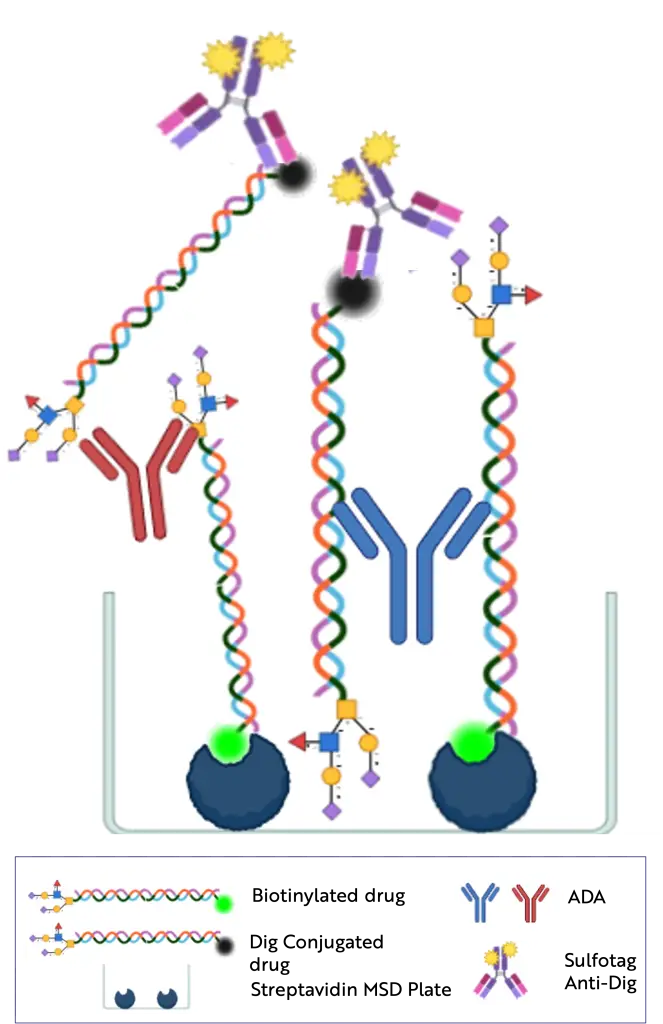
The Gyrolab evaluation tested a 200 CD (with off instrument incubation of the acid and neutralisation mastermix) and mixing CD formats allowing comparison of on and off-instrument acid dissociation, buffer and MRD optimisation, and reagent concentration optimisation.
The approach involved required an appropriate reagent toolkit as detailed below:
- Biotin and digoxigenin conjugated drug should be available to use as capture and detection reagents.
- MSD GOLD 96-well Small Spot Streptavidin Plates.
- Metabolites to test metabolite interference (if required) and for an additional characterization tier
(if required). - An appropriate positive control (PC) which has been generated against the therapeutic is required, a polyclonal antibody is preferable.
- If GalNAc characterization is required a positive control against GalNAc will also need to be generated (or a polyclonal PC that binds to the whole therapeutic can also be used).
Developing Immunogenicity Assays for a Novel Modality?
Resolian’s ligand binding assay team has validated ADA methods across MSD and Gyrolab platforms for GalNAc-siRNA therapeutics and other complex biologics.
Results
The Gyrolab platform achieved sensitivity equivalent to the MSD format and a comparable hook effect threshold, however it showed greater variability in the negative control and blank individual responses and would have required further optimisation to reach acceptable performance. The MSD method demonstrated good performance across all parameters in the development, including good precision, demonstrating that singlicate analysis could be used going forward.
The validated MSD method demonstrated:
- Screening cut point: 1.12 (95% CI); confirmatory cut point: 30% inhibition (99% CI); titer cut point: 1.3 (99.99% CI)
- Screening sensitivity: 12 ng/mL at the 50th percentile, 26 ng/mL at the 99th percentile.
- Confirmatory sensitivity: 33 ng/mL at the 50th percentile, 74 ng/mL at the 99th percentile.
- No hook effect detected up to 120 µg/mL of PC
- Screening precision: intra-assay below 9% CV, inter-assay below 11% CV
- Confirmatory precision: intra-assay below 19% CV, inter-assay below 15% CV
- Drug and metabolite tolerance suitable for expected clinical sample concentrations
- Selectivity confirmed across healthy, haemolysed, and lipemic matrices
- Short-term stability confirmed for 24 hours at room temperature and across 9 freeze-thaw cycles
The validated method supports a three-tier testing paradigm: screening, confirmatory (whole drug), and titer, with the option to add a GalNAc-specific confirmatory tier to further characterise antibody specificity, subject to availability of an appropriate positive control against the GalNAc moiety.
What This Means
This work provides a practical blueprint for ADA assay development in the GalNAc-siRNA space: demonstraiting platform comparison, reagent toolkit requirements, metabolite interference strategy, and a tiered confirmatory approach for specificity characterisation.
For sponsors advancing GalNAc-siRNA programmes into the clinic, having a validated immunogenicity method and a clear framework for further characterisation reduces one of the key uncertainties in first-in-human planning.
As siRNA therapeutics become more structurally diverse and clinically ambitious, Resolian’s experience across both MSD and Gyrolab platforms positions the team to support the growing pipeline of oligonucleotide therapeutics requiring immunogenicity assessment.
Ready to Build Your siRNA Immunogenicity Programme?
Resolian partners with pharma and biotech companies to develop and validate fit-for-purpose ADA assays across novel modalities, from first-in-human planning through clinical study support.