
BLOG
Running a drug development program across more than one country multiplies almost every risk you already have. Different regulators expect different things. Samples cross more borders. Data has to mean the same thing whether it’s generated in Cambridgeshire or Chongqing. Choosing the right bioanalytical CRO for global drug development means finding a partner who looked great for your Phase I in one region and stays equally strong when your program moves somewhere else.
Here are 7 proven steps that separate a strong bioanalytical CRO for global drug development from a future headache.
What to look for in a bioanalytical CRO for global drug development
1. Start with regulatory consistency, not just regulatory experience
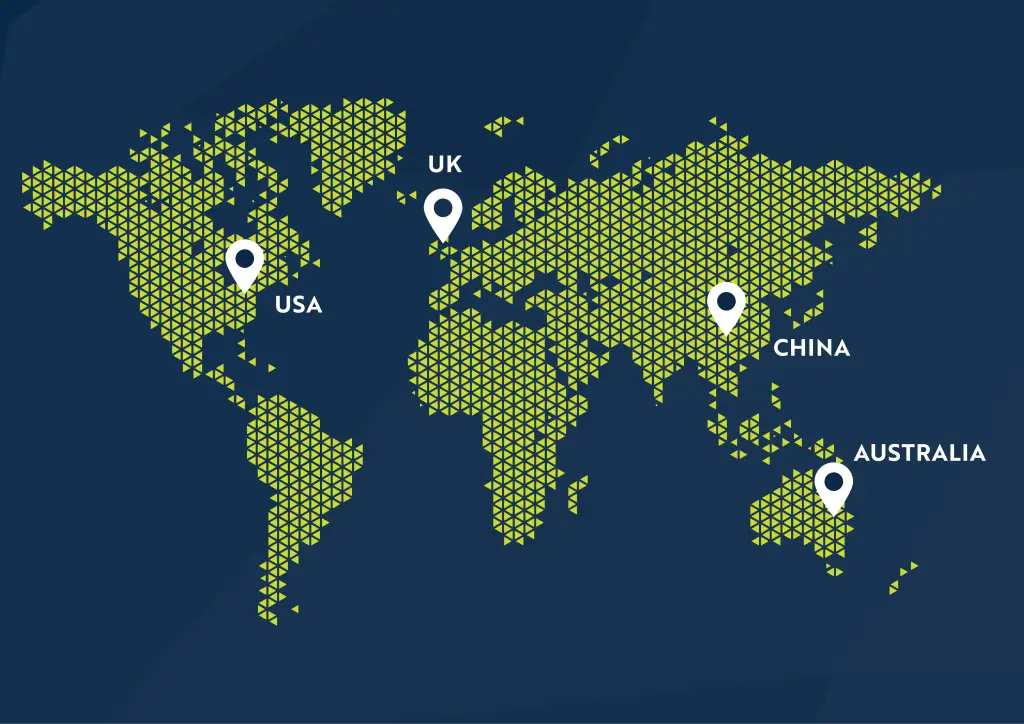
Almost every CRO can claim FDA, EMA, or MHRA experience somewhere in their history. What matters more, for any bioanalytical CRO supporting global drug development, is whether they apply one quality standard across every lab in their network, so a method validated in the US holds up the same way when your program moves to the UK, Australia, or China. The ICH’s harmonised guidelines exist precisely because sponsors need that consistency across borders, not a patchwork of local standards. If your data package looks different depending on which site ran it, that inconsistency becomes your problem at inspection time, not theirs.
2. Check whether the lab footprint actually matches your trial’s geography
This is one of the clearest signals of a genuine global bioanalytical CRO, rather than one that outsources when a program crosses a border. A partner with labs positioned across the regions your trial will actually run in, rather than a single home base with occasional overseas subcontracting, means less time lost to sample shipping logistics, chain-of-custody handoffs, and time zone gaps between your team and the bench. Resolian’s Fordham and Brisbane labs are a useful example of what real global footprint looks like in practice: genuine capacity in each region, not a satellite office.
3. Look for modality-specific, recent evidence, not a long capability list
Oligonucleotides, ADCs, biologics, cell and gene therapy, and small molecules all carry different bioanalytical failure points, non-specific binding, matrix effects, stability under GxP conditions. A bioanalytical CRO worth choosing for global drug development should be able to point to recent, relevant validation work in your modality, not a generic services page.
4. Ask how they handle the handoff between phases and geographies
This is where multi-country programs actually break, and it’s the test that separates a genuine global drug development partner from one that’s global in name only. Method transfer between sites, consistent data formats, and a single point of accountability matter more than any individual lab’s technical brilliance. If method transfer between your Phase I site and your Phase II site requires re-validation from scratch, you’ve lost time and possibly comparability.
5. Confirm capacity, not just capability
A lab can have the right instrumentation and the wrong queue. Ask directly about committed slots against your actual timeline, not a general statement of expertise.
6. Evaluate governance as carefully as the science
A named program lead, clear escalation paths, and a defined communication cadence across time zones prevent the small misunderstandings that turn into missed deadlines when your team and your lab are twelve time zones apart. Governance like this is what makes a bioanalytical CRO genuinely usable for global drug development, not just theoretically capable of it.
7. See how it all works together at one partner
Resolian runs bioanalytical and analytical sciences labs across the US, UK, Australia, and China under one quality standard, so a study that starts in Malvern and moves to Brisbane or Chongqing doesn’t require rebuilding trust in a new partner from scratch. Method validation, data formats, and quality expectations carry across every site, which is the whole point of choosing a single bioanalytical CRO for global drug development rather than a patchwork of regional labs. See Resolian’s full lab network for more detail.
The bottom line
For a multi-country program, the right bioanalytical CRO for global drug development isn’t the one with the longest capability list. It’s the one who can prove their quality standard doesn’t change depending on which lab generated the data, and who can follow your program as it moves.
Ready to talk through your program’s geography and timelines?
Talk to our bioanalytics team →
Frequently Asked Questions
How do I know if I need a bioanalytical partner for biopharma startups, or an in-house team?
If you don’t yet have a dedicated bioanalytical function, or your first study is 12 months or less away, an external partner is almost always faster and lower-risk than building internal capability from scratch.
How long does it take to onboard a bioanalytical partner for biopharma startups?
Timelines vary by modality and method complexity, but most method feasibility and validation work can begin within a few weeks of a signed scope, assuming reference standards and matrix are available.
What's the difference between a CRO and a bioanalytical partner for biopharma startups?
Any CRO can run an assay. A true partner brings modality-specific method experience, global regulatory credibility, and proactive communication — the things that protect your timeline rather than just filling a lab slot.