
bioanalysis
Background
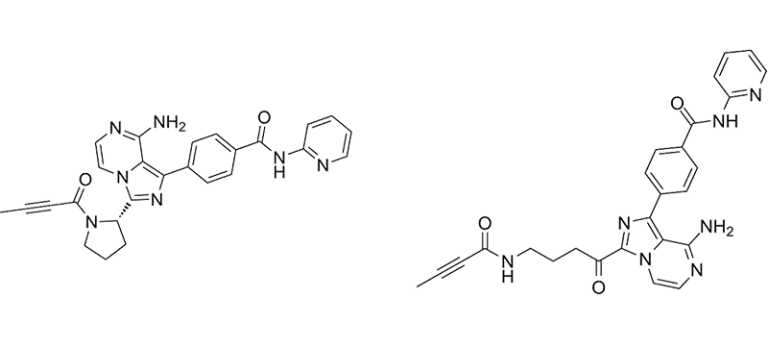
Acalabrutinib is a second-generation Bruton’s tyrosine kinase (BTK) inhibitor approved for the treatment of chronic lymphocytic leukemia and mantle cell lymphoma. It was designed to address the selectivity limitations of first-generation BTK inhibitors like ibrutinib, minimizing off-target kinase binding and the adverse events associated with it. ACP-5862 is acalabrutinib’s primary active metabolite, formed through CYP3A metabolism. It retains substantial BTK inhibitory activity and contributes meaningfully to overall drug efficacy, which means that understanding the full pharmacokinetic picture requires measuring both parent compound and metabolite simultaneously. This is particularly important when patients are receiving concurrent CYP3A modulators, where drug-drug interactions can meaningfully shift the acalabrutinib to ACP-5862 ratio and the overall PK profile.
The Challenge
Developing a single validated assay capable of quantifying both acalabrutinib and ACP-5862 from the same plasma aliquot requires chromatographic conditions that resolve both acalabrutinib and its ring-opened metabolite. The molecular structures present their own constraints: acalabrutinib’s pyridopyrimidine core and multiple amide groups are well suited to positive ion mode MS, but the opening of pyrrolidine ring of acalabrutinib and induction of ketone group alters ACP-5862’s chemical properties and pKa. Finding the right column and mobile phase combination to achieve symmetric peaks for both analytes requires systematic screening. Simplicity was also a design goal: a method requiring complex, multi-step sample preparation would add run time and reduce throughput in a clinical support context where turnaround matters.
Our Approach
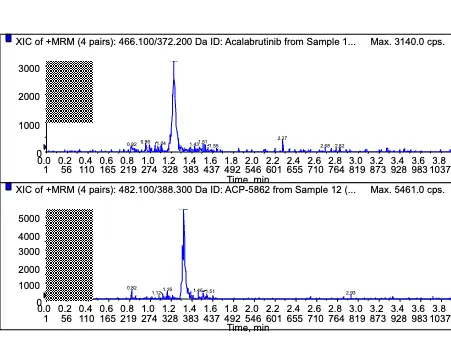
Multiple columns and mobile phase combinations were systematically evaluated to achieve symmetric peak shapes for both analytes without carryover. The XSelect Premier CSH Phenyl-Hexyl column (2.1 x 50 mm, 2.5 µm) was selected as the optimal choice, using a mobile phase consisting of ammonium bicarbonate, formic acid, water, and MeCN. This combination provided symmetry peak shape and baseline separation with no carryover observed at or above the LLOQ.
Sample preparation was deliberately kept simple: protein precipitation with MeCN, followed by dilution with aqueous ammonium bicarbonate solution. The entire extraction process takes approximately 20 minutes. Isotope-labelled internal standards, acalabrutinib-d4 and ACP-5862-d4, were used for each analyte respectively, providing robust compensation for any variation. Detection was performed on a Sciex Triple Quad 6500 in positive ion mode.
The method was validated in both LiHep and K2EDTA human plasma, with a dilution QC at 5,000 ng/mL. Selectivity and matrix effect assessments covered six individual lots of normal plasma plus hemolyzed and lipemic matrices with each anticoagulant.
Need to Quantify a Parent Drug and Its Active Metabolite Together?
Resolian’s team builds simple, high-throughput HPLC-MS/MS methods that resolve closely related compounds in a single validated assay, without adding complexity to your sample workflow.
Results
The validated method delivered:
- Calibration range: 1.00 to 1,000 ng/mL for both analytes in human K2EDTA and LiHep plasma
- LLOQ: 1.00 ng/mL with adequate signal-to-noise ratio and no carryover
- Inter-assay accuracy: -3.7 to 8.3% bias for acalabrutinib; -1.3 to 8.3% bias for ACP-5862
- Inter-assay precision: 3.7 to 7.7% CV for acalabrutinib; 3.7 to 14.7% CV for ACP-5862
- No interference or matrix effect observed in any of the eight plasma lots tested (including hemolyzed and lipemic)
- Full stability package established: sample collection stability on wet ice and at room temperature, processed sample stability for 289 hours, freeze-thaw stability across 4 cycles, benchtop stability for 23 hours, and long-term stability for 29 days at -20 degrees C
- 20-minute extraction time, supporting high-throughput clinical sample turnaround
What This Means
For clinical laboratories supporting BTK inhibitor programs, having a validated 2-in-1 assay that quantifies both acalabrutinib and its active metabolite from a single 20-microlitre plasma aliquot with a 20-minute extraction is a practical advantage. The method’s clean performance across two anticoagulant types and multiple matrix variants means it can be deployed flexibly across study designs without additional method bridging work. As drug-drug interaction studies become more central to precision oncology regimens involving CYP3A inhibitors or inducers, having reliable simultaneous PK data for the drug and its metabolite from the same sample supports more informative clinical decision-making.
Ready to Simplify Your Oncology PK Assay?
Resolian partners with pharma and biotech companies to deliver simple, validated small molecule LC-MS/MS methods for oncology drugs and their active metabolites, from method development through clinical support.