
Inverse Gas Chromatography – Surface Energy Analysis (iGC-SEA)
What your material’s surfaces are telling you, and whether you’re listening.
Surface properties drive formulation performance, processing behaviour, and product stability.
Yet they remain one of the most undercharacterised aspects of pharmaceutical development.
Resolian’s iGC-SEA service delivers precise, quantitative surface energy data across the full development lifecycle.
From raw material screening and excipient compatibility through to batch variability and supplier qualification, our analysts give you the decision-ready data to move forward with confidence, based on evidence rather than assumption.
What is iGC-SEA?
iGC-SEA is a versatile, gas-phase sorption technique designed specifically to measure surface energy heterogeneity in solid materials. Unlike conventional gas chromatography, it uses your material as the stationary phase, passing known probe vapours through it to reveal the physicochemical properties of its surface.
The result is quantitative, high-resolution data on surface chemistry: precise enough to detect subtle differences between batches, sensitive enough to inform critical formulation and processing decisions.
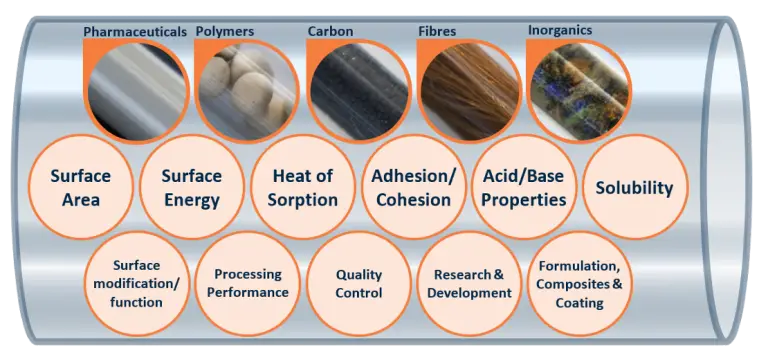
Typical applications
- Formulation component interactions and API-excipient compatibility
- Product Stability monitoring
- Batch-to-batch and supplier variability assessment
- Raw material screening and evaluation
- Understanding the impact of process variations on surface properties
Benefits of iGC-SEA
Our iGC-SEA service is designed to deliver decision ready data, helping to reduce risk and gain confidence in material selection and formulation strategy.
- In-situ sample pre-conditioning providing application relevant insights
- Wide temperature range and humidity control enabling the mimic of real-world conditions
- Clear scientific interpretation and tailored reporting to support informed decision making
- Direct comparison across samples, batches and suppliers
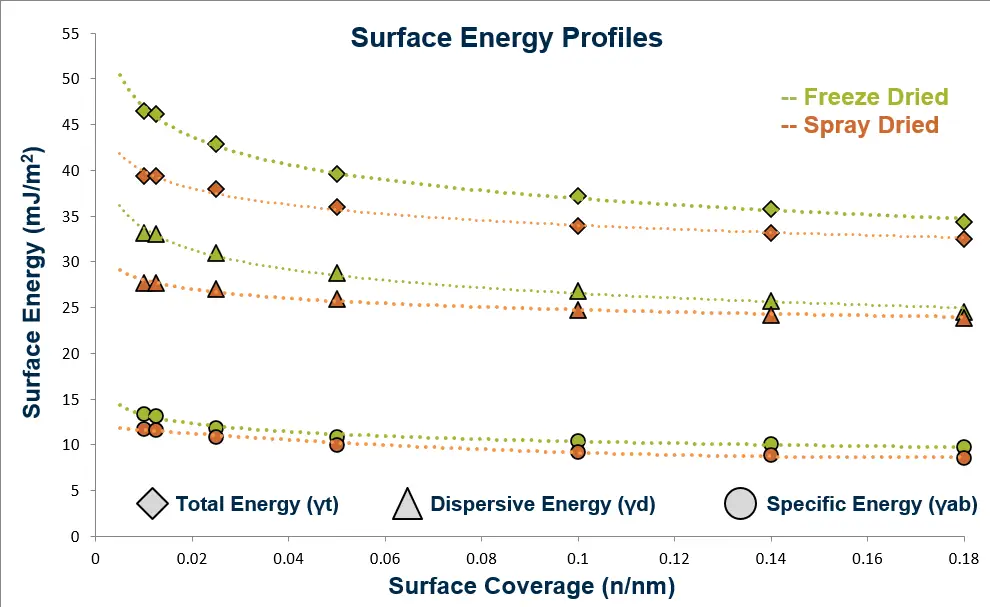
Analysis outputs
With over a decade of experience, our iGC-SEA analysts generate high-quality data outputs that enable reliable comparison of surface properties across samples or conditions with clear graphical interpretations of analytical data.
- Surface Area Isotherm determination and BET SSA calculation
- Surface Energy Profiles and distributions
- Dispersive, Specific and Total Surface Energy, across multiple percentiles
- Specific Free Energy of vapour polar probes
- Surface Heterogeneity interpretation
- Work of Adhesion and Cohesion
- Investigate the relationship between excipients and API
- Heat of Sorption
- Isosteric heat of adsorption for polymers, catalysts, and fillers
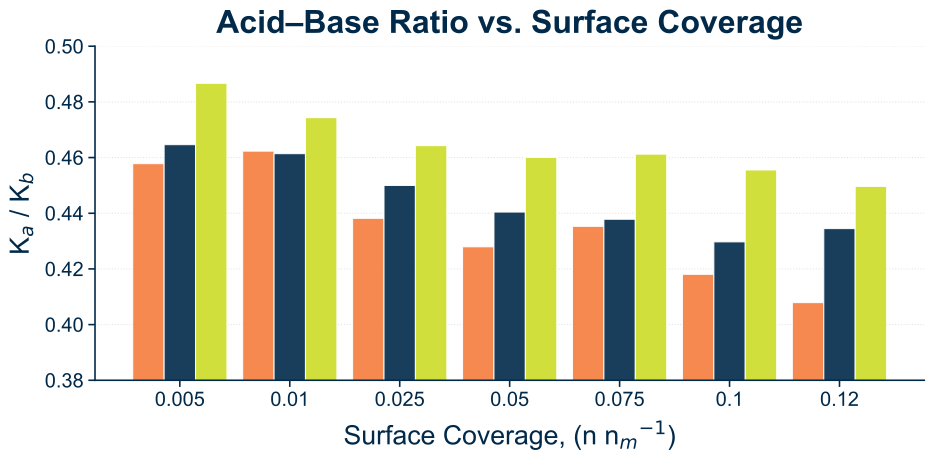
- Acid-Base Surface Chemistry
- Ka and Kb as a function of surface coverages of sample
- Ka/Kb Ratio Profile
Understand your material. Control your formulation.
Surface properties shape every stage of development.
Resolian’s iGC-SEA service gives you the data to make better decisions, faster.
Proven in practice
iGC-SEA isn’t just a capability, it’s a capability that has solved real problems for real development teams.
These case studies show how Resolian’s surface energy expertise has helped clients move forward with confidence.

Surface Energy and Sucrose: Why Milling Method Matters More Than Particle Size

Understanding Nanoparticle Surfaces: A New Analytical Approach for Nanomedicine Research
Industries
Our iGC-SEA capability serves regulated industries including:
- Pharmaceuticals
- Chemical
- Personal Care
- Tobacco
- Composite Materials
- Food
- Building Materials
- Aerospace
- Energy
- Nuclear
Why choose Resolian for Surface Energy iGC-SEA Analysis?
Surface energy analysis is only as valuable as the expertise behind it. Resolian brings over a decade of iGC-SEA experience, giving you access to analysts who understand not just the technique, but what the data means for your programme.
Working with a single, specialist laboratory means your material is set up, characterised, and interpreted in one place, removing handoff risk and keeping your timelines intact. From early raw material screening through to commercial batch assessment, our team provides consistent support at every stage, so there are no gaps in understanding as your programme advances.
Whether you need a single sample analysis or a high-throughput testing programme, our service is structured to scale with your project. Every engagement includes expert method development and intrepretation, ensuring your data is robust, defensible, and fit for purpose.
Frequently Asked Questions: Inverse Gas Chromatography (iGC-SEA).
Find answers to commonly asked questions about Inverse Gas Chromatography (iGC-SEA) at Resolian.
What is iGC-SEA and how does it differ from conventional gas chromatography?
Inverse Gas Chromatography for Surface Energy Analysis (iGC-SEA) works in reverse to conventional GC. Instead of analysing a vapour mixture using a known stationary phase, iGC-SEA uses your material as the stationary phase and passes known probe vapours through it. This allows the technique to characterise the surface properties of the solid, including surface energy, surface heterogeneity, acid-base chemistry, and work of adhesion. It is a gas-phase technique, which means it does not alter or dissolve the material during analysis.
Why does surface energy matter in pharmaceutical development?
Surface energy influences how particles interact with each other and with excipients, how powders flow and compact during processing, how a drug substance adheres to surfaces or resists wetting, and how stable a formulation remains over time. Small differences in surface energy between batches or suppliers can have significant downstream consequences for processability, bioavailability, and product performance. iGC-SEA gives you quantitative data on these properties rather than relying on indirect inference.
What types of materials can be analysed by iGC-SEA?
iGC-SEA is applicable across a broad range of pharmaceutical and non-pharmaceutical materials, including APIs, excipients, polymers, fibres, inorganic fillers, carbon materials, and composite substrates. The technique is particularly valuable for powders and granular materials where surface properties are critical to performance.
Can iGC-SEA support batch-to-batch and supplier comparisons?
Yes. iGC-SEA is well-suited to detecting subtle differences in surface chemistry between batches or across suppliers, differences that may not be apparent from conventional physical characterisation. The technique produces reproducible, quantitative profiles that allow direct comparison across samples under the same controlled conditions.
What outputs does Resolian's iGC-SEA analysis provide?
Resolian’s analysts deliver a comprehensive data package including surface energy profiles and distributions (dispersive, specific, and total), BET specific surface area, acid-base surface chemistry (Ka, Kb, Ka/Kb ratio profiles), work of adhesion and cohesion, heat of sorption, and surface heterogeneity interpretation. All outputs include clear graphical representations and a scientific interpretation report tailored to your specific questions.
How does iGC-SEA compare to other surface energy measurement techniques?
Unlike contact angle measurements, which assess a single point on a compressed or cast surface, iGC-SEA measures the energetic heterogeneity across the entire accessible surface of a powder under conditions closely matched to real-world processing environments. This makes it significantly more informative for development decisions involving APIs and excipients in their native powder state.
Can you match real-world storage or processing conditions during analysis?
Yes. Resolian’s iGC-SEA instrumentation offers in-situ sample pre-conditioning, wide temperature range capability, and humidity control, allowing the analysis to be conducted under conditions that reflect the conditions your material will actually encounter during manufacture, storage, or use.
At what stage of development is iGC-SEA most useful?
iGC-SEA adds value throughout the development lifecycle. In early development it supports raw material screening, API solid form selection, and excipient compatibility assessment. During formulation and process development it informs processing decisions and stability risk. In late-stage and commercial manufacturing it supports batch variability, supplier qualification, and root cause analysis for unexpected performance variation.
Your material’s surface properties are telling a story.
We help you read it.
Whether you’re screening raw materials, troubleshooting a formulation challenge, or qualifying a new supplier,
Resolian’s iGC-SEA team delivers the precise, decision-ready data you need to move forward with confidence..