
ANALYTICAL SCIENCES
EXTRACTABLES AND LEACHABLES
CASE STUDY
Background
During pharmaceutical manufacturing and storage, chemical constituents from packaging, container closure systems, and delivery devices may migrate into drug products.
These species represent a potential safety and quality risk that must be systematically characterised and assessed. USP chapters <1663> and <1664> and the USP Stimuli proposal for system suitability, alongside the draft ICH Q3E guideline, set out the expectations for extractables and leachables (E&L) evaluation across the product lifecycle, with non-targeted LC-HRAMS screening at the heart of most modern analytical programmes.
For LC-MS screening to be reliable and reproducible, system suitability testing is essential. The Resolian Analytical Sciences Extractables & Leachables team performs LC-HRAMS screening using methodology aligned with USP stimulus criteria, which define the attributes a system suitability test (SST) mixture should demonstrate: anchor compounds spanning the chromatographic range, critical pairs to assess resolving power, sensitivity markers, overlapping compounds detectable by orthogonal screening methods, precision trackers, chemical diversity, and toxicologically relevance.
The Challenge
The existing SST mixture in use contained fifteen components, a number that had grown organically to meet coverage requirements but carried practical disadvantages.
Several components showed limited stability under routine screening conditions, creating variability in system suitability results and requiring additional investigative work when failures occurred.
A mixture containing unstable components can undermine routine screening robustness. Each avoidable SST failure can trigger investigation, delay sample analysis, and reduce confidence in day-to-day method performance. The challenge was to reduce complexity and improve robustness without sacrificing coverage of the USP stimulus attributes that make the SST meaningful.
Our Approach
The Resolian team systematically evaluated candidate compounds against the full set of USP SST stimulus criteria, assessing each on retention time, MS response, peak shape, and stability under the Resolian’s in-house LC-HRAMS screening conditions.
For early-eluting anchor and precision compounds, caffeine and theobromine were confirmed as suitable, based on retention, peak shape, and MS response. Several other early-eluting candidates were excluded due to inadequate chromatographic or spectral performance. For late-eluting compounds, Irgafos 168, a component of the original mixture, was removed due to limited stability. Plastic Additive 10 (Cyanox STDP) was introduced as a replacement late-eluting anchor, offering improved stability, better MS response, and an extended retention time range that enhances chemical diversity coverage. The final selection also retained ionisation mode diversity to support broader LC-MS performance monitoring.
The optimised final SST mixture contains nine components: theobromine, caffeine, methylparaben, 2-mercaptobenzothiazole, Irganox 245, Tinuvin P, Uvinul 3030, Irganox 1076, and Plastic Additive 10. Together these cover key USP stimulus attribute categories: anchor points, critical pairs, sensitivity, compounds detectable by orthogonal screening methods, precision markers, chemical diversity, and toxicologically relevant species.
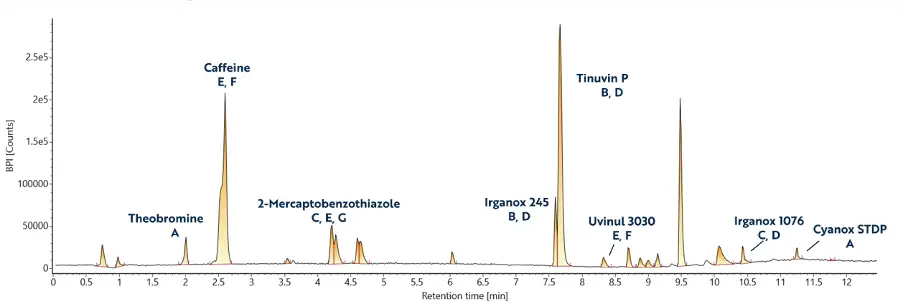
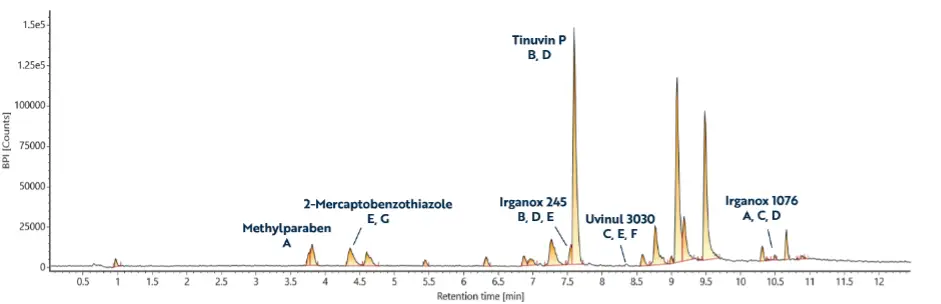
A. Anchor: Earliest and latest eluting compounds.
B. Critical pair: Compounds that elute closely to establish the chromatographic efficiency and resolving power of the method.
C. Sensitivity: Compounds that are detectable at low concentration to confirm detector sensitivity.
D. Overlapping: Compounds that are detectable by the method and a second screening method, e.g. GC-MS.
E. Precision: Compounds that elute throughout the chromatogram to establish the method’s injection precision.
F. Chemical diversity: Ensures the mixture is chemically diverse.
G. Potentially toxic: Compounds that could pose a toxicological safety risk.
Results
The optimised SST mixture delivered:
- Component count reduced from fifteen to fewer than ten, simplifying preparation and reducing variability from unstable species
- Coverage of key USP stimulus attributes maintained across the reduced mixture
- Improved robustness under routine screening conditions by removing components with demonstrated stability limitations
- Extended retention time window achieved through the inclusion of Cyanox STDP as a late-eluting anchor, improving overall chromatographic range coverage.
- Ionisation mode coverage retained to support LC-MS performance monitoring across diverse E&L compound classes
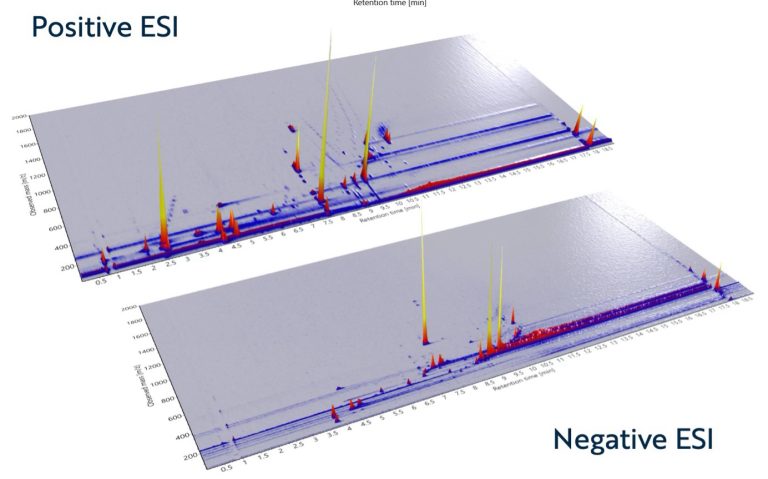
- 3D mass chromatogram visualisation confirmed that co-eluting compounds can be fully resolved based on their accurate mass, validating the approach for non-targeted screening
What This Means
A system suitability test is only useful if it performs reliably under routine conditions. Removing unstable components is not a simplification for its own sake: it directly improves the reproducibility of routine screening runs, reduces the avoidable SST investigations, and increases confidence in the analytical data generated for Extractables and leachables assessment.
The optimised mixture is fit for purpose as a performance monitor for Resolian’s non-targeted E&L LC-MS screening workflows, and the evaluation framework used to develop it is directly applicable to ongoing optimisation as new USP guidance evolves.
As ICH Q3E progresses through consultation and finalisation, Resolian’s SST capability provides a strong foundation for USP aligned, high-quality E&L programs.
Ready Ready to Strengthen Your E&L Screening Program?
Resolian’s Analytical Sciences team supports extractables and leachables programs from screening through safety qualification,
with USP and ICH-aligned methodologies built for regulated pharmaceutical environments.