| Technique | What Property Does It Measure? | What Is The Information Used For? |
Physicochemical Properties | Inverse Gas Chromatography (iGC) | Surface energy | • Determination of surface interactions within formulations |
Dynamic Vapor Sorption (DVS) | Solvent interaction, hygroscopicity | • Formulation and packaging design | |
Fourier Transform Infrared (FT-IR) Spectroscopy | Chemical structure and identity | • Material identity confirmation | |
Others | Viscosity, pH, Karl Fisher | Flowability, homogeneity, stability, solubility, dissolution rate, moisture content | |
Size & Shape | Light Microscopy | Particle size, shape and morphology | • Choosing optimal parameters for other techniques, e.g. laser diffraction |
Scanning Electron Microscopy (SEM) | Particle size, shape, morphology, behavior and interactions | • Nano- and micro-scale size and shape assessment | |
Laser Diffraction | Particle size distribution (PSD) | • Studying the effects of processing e.g. milling | |
Dynamic Image Analysis (QICPIC) | Particle size and shape | • Better description of size and shape of non-spherical particles | |
Light Obscuration (HIAC) | Particle size | • Performing visible and sub-visible particulate matter testing | |
Surface | Gas Adsorption Analysis | Specific surface area and porosity | • Understanding dissolution rate, processing, useful shelf-life and bioavailability |
Density | Gas pycnometry | True density and volume | • Ensuring quality and consistency of materials |
Bulk & Tap Density | Density, packing properties | • Determine flowability, compressibility, compactability | |
Solid Form Characterization | Powder X-ray Diffraction (PXRD) | Crystallinity, crystal structure, polymorphism, amorphous content, purity, phase identity | • Phase identification and purity |
Differential Scanning Calorimetry (DSC) | Solvates, Hydrates, Glass Transition, Melting Point, Thermal Stability | • Determining compatibility and interactions between formulation components | |
Thermogravimetric Analysis (TGA) | Thermal stability, volatiles content (e.g. moisture, solvent), purity | • Determining hydration / solvation levels | |
Hot Stage Microscopy | Melting/boiling point, thermal stability, desolvation, phase transitions, miscibility | • Supporting formulation development | |
Fourier Transform Infrared (FT-IR) Spectroscopy | Chemical structure and identity | • Material identity confirmation |
Our Research
Discover our recent findings, catch up with news, and review in-depth resources and case studies.
Australian Clinical Trials Podcast
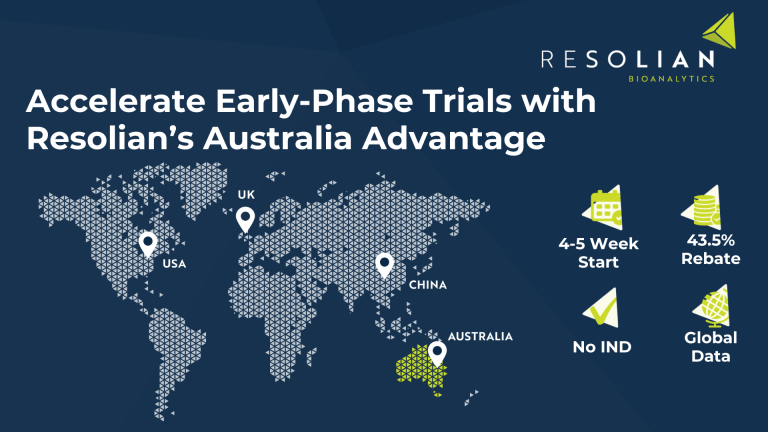
In this visual podcast we explore why Australia is an attractive destination for early-phase clinical trials, highlighting the benefits of speed, quality, and cost-effectiveness.
The expert panel discussion delves into Australia’s unique regulatory pathways, the R&D tax incentives, operational logistics, and how early-phase data supports global drug development.
Navigating the Transition from Titanium Dioxide (TiO2) in Pharmaceuticals
Titanium dioxide (TiO2) has been a critical excipient in pharmaceuticals for decades, offering exceptional opacity, whiteness, and stability. However, evolving regulatory demands are driving the industry to explore alternatives. Resolian provides advanced analytical and characterization support to guide this transition while ensuring product quality and compliance.
Flow Cytometry Sample Processing Packages
Our Flow Cytometry team have designed a sample processing package that solves the logisitcally challenges with samples.
Harmonizing Quality Standards Across Global Labs with David Butler
In a globalized life sciences industry, maintaining consistent quality standards across multiple international sites is a major challenge.
Globally Harmonized Labs
Leading the Way in Secure, Cross-Border Analytical Solutions. We’re committed to delivering seamless scientific expertise that’s globally integrated and locally specialized.
Biomarker Assay List
Our extensive biomarker method experience is outlined in the following list, but it’s not exhaustive.