
bioanalysis
CASE STUDY
Background
The rapid growth of siRNA therapeutics has created an equally rapid need for reliable quantitative bioanalysis in biological matrices. Since the first FDA approval in 2018, siRNA programmes have multiplied, and the demands on bioanalytical teams have grown with them. siRNA presents a specific combination of challenges that conventional methods have not yet fully resolved: duplex instability during sample processing, extremely low circulating drug concentrations in clinical samples, and the need to distinguish parent drug from closely related metabolites.
Standard LC-MS/MS provides good structural selectivity but has historically been limited to lower limits of quantitation around 200 pg/mL for duplex siRNA. Ligand-binding assays can push sensitivity further but cannot reliably differentiate full-length siRNA from N-1 or other truncated metabolites. Hybrid LC-MS/MS, combining hybridisation-based capture with mass spectrometric detection, offers a path to overcome both limitations simultaneously.
The Challenge
The programme required quantitation of a 23-nucleotide siRNA (RBM2512) and its major N-1 metabolite (AS(N-1)3′ RBM2512) in human plasma, with a target LLOQ well below the sensitivity threshold achievable with conventional LC-MS/MS.
The analytical challenge was compounded by duplex instability during sample handling, the need for chromatographic resolution of closely related sequences differing by a single nucleotide, and the requirement for a clean assay free of carryover after high-concentration injections. An internal standard strategy also had to be incorporated that could track both extraction variability and run-to-run analytical fluctuations without interfering with the target analyte signals.
Our Approach
Resolian’s team systematically optimised a hybrid LC-MS/MS workflow across four interdependent areas: extraction, hybridisation, chromatography, and MS parameters. Sample preparation began with proteinase K digestion of 200 microlitres of plasma, followed by hybridisation of the antisense strand with a complementary biotinylated PNA probe. The resulting duplexes were captured on magnetic streptavidin beads, washed, and eluted under high-temperature denaturing conditions before injection.
Chromatographic separation was achieved using a Thermo DNAPac RP column with DIPEA-based ion-pair mobile phases, which produced symmetrical peak shapes for both analytes and the internal standard across the full concentration range. A novel backflush workflow using a third pump and switching valve was implemented to eliminate carryover and improve run-to-run reproducibility. No carryover was detected in matrix blank injections following ULOQ samples.
The internal standard was a 20-nucleotide 2’OMe RNA construct sharing sequence similarity with the antisense strand of RBM2512, selected for its ability to track both extraction efficiency and analytical variability. Detection was performed on a SCIEX Triple Quad 6500+ in negative electrospray ionisation mode.
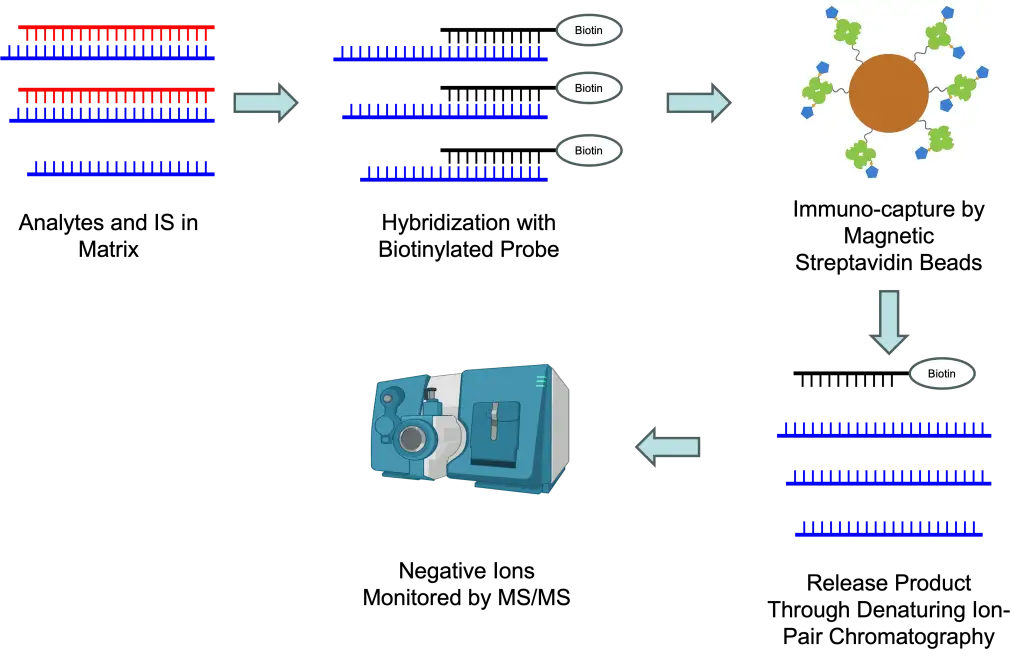
Working with Duplex siRNA Instability or Low Circulating Concentrations?
Resolian’s team has developed a hybrid LC-MS/MS workflow combining hybridization-based capture with mass spectrometric detection, purpose-built to solve the sensitivity and selectivity limits standard methods can’t reach.
Results
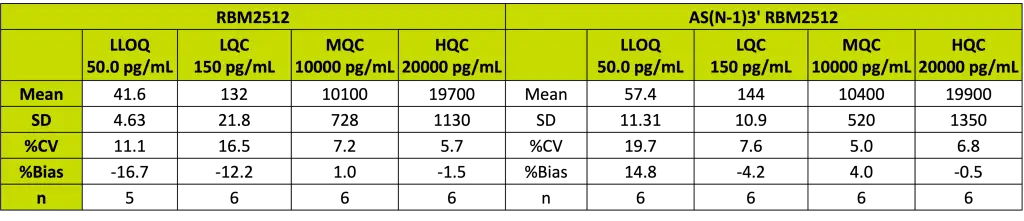
The method achieved an LLOQ of 50 pg/mL for both RBM2512 and its N-1 metabolite across a quantitation range of 50.0 to 25,000 pg/mL. This represents a four-fold improvement over the previously accepted MS-based sensitivity threshold for duplex siRNA. Key performance metrics:
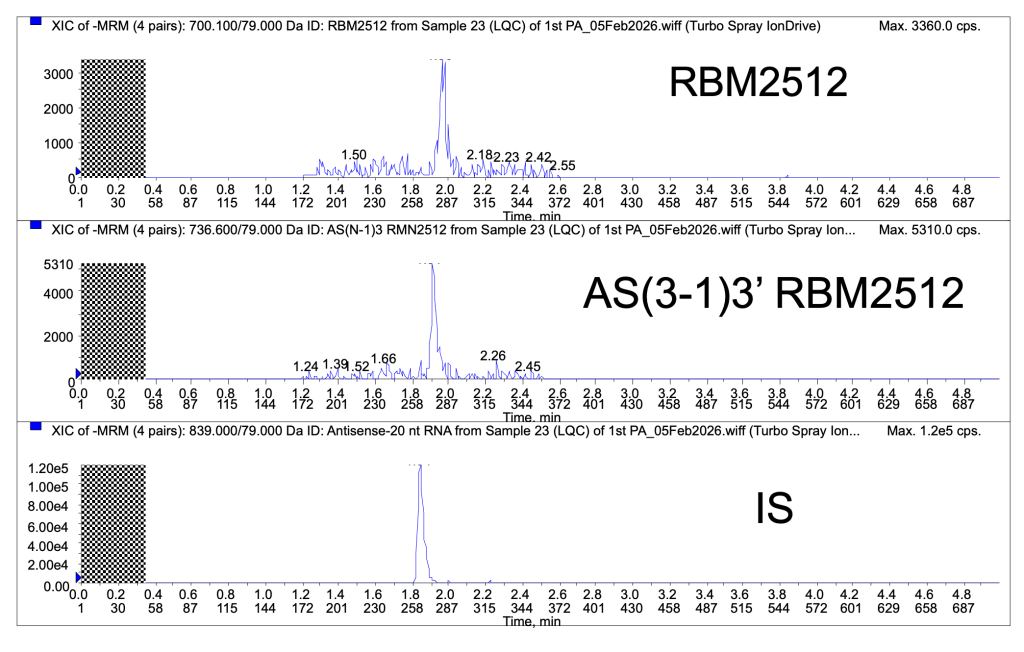
- LLOQ: 50.0 pg/mL for both analytes, with signal-to-noise ratios above 5
- Accuracy: 83.3 to 98.6% for RBM2512; 95.8 to 114.8% for AS(N-1)3′ RBM2512 across QC levels
- Precision: %CV within regulatory acceptance limits across all QC concentrations
- No carryover detected in matrix blank after ULOQ injection
- Calibration R-squared values above 0.989 for both analytes using 1/(x squared) weighted linear regression
What This Means
An LLOQ of 50 pg/mL for duplex siRNA sets a new benchmark for what hybrid LC-MS/MS can achieve in regulated bioanalysis. For sponsors developing siRNA programmes, this level of sensitivity means that clinical PK sampling can be designed around what the biology requires, not what the assay can detect.
The simultaneous quantitation of parent siRNA and its primary metabolite in a single validated method also reduces the analytical burden in multi-analyte studies. Resolian continues to apply this hybrid approach across a growing portfolio of oligonucleotide therapeutics, building assay-ready capabilities for the programmes that will define the next decade of RNA medicine.
Ready to Set a New Sensitivity Benchmark for Your siRNA Programme?
Resolian partners with pharma and biotech companies to deliver ultra-sensitive hybrid LC-MS/MS methods for siRNA and oligonucleotide therapeutics, from method development through regulated validation.