Resolian developed an extraction-free, direct-to-qPCR workflow that accurately quantifies therapeutic oligonucleotides across plasma and multiple tissue types using a single calibration curve, reducing hands-on time and cost without compromising performance.
bioanalysis
Authors:
Swati Dass, David Zuluaga, and Aihua Liu
Background
Oligonucleotide therapeutics are advancing rapidly, with an increase in demand of analysing the oligos for pharmacokinetics and biodistribution studies. Traditional platforms, including LC-MS and ligand-binding assays, often struggle to deliver the sensitivity and sequence specificity needed.
Quantitative PCR addresses that sensitivity gap, but conventional qPCR workflows carry their own burden: labor-intensive nucleic acid extraction, matrix-dependent inhibition, and the need for matrix-matched standard curves at every step. The cumulative effect is longer timelines, higher costs, and more variables to manage during method development.
The Challenge
For sponsors quantifying oligonucleotides across plasma and multiple tissue types, the standard approach creates real friction. Extraction steps consume time and samples. Matrix-driven Ct shifts require extensive optimization work. And running separate standard curves for each tissue type adds complexity at every stage of a study.
The question was whether it was possible to eliminate extraction entirely while maintaining the analytical performance required for regulated bioanalysis, across all relevant matrices, from a single calibration platform.
Our Approach
Resolian’s team developed and systematically evaluated an extraction-free, direct-to-qPCR workflow using optimized detergent-based homogenization combined with controlled matrix dilution. Plasma and non-human primate tissues were lysed using detergents and proteinase K. Rather than extracting nucleic acids, samples were serially diluted to a point where matrix inhibition was effectively neutralized while maintaining the signal to noise ratio.
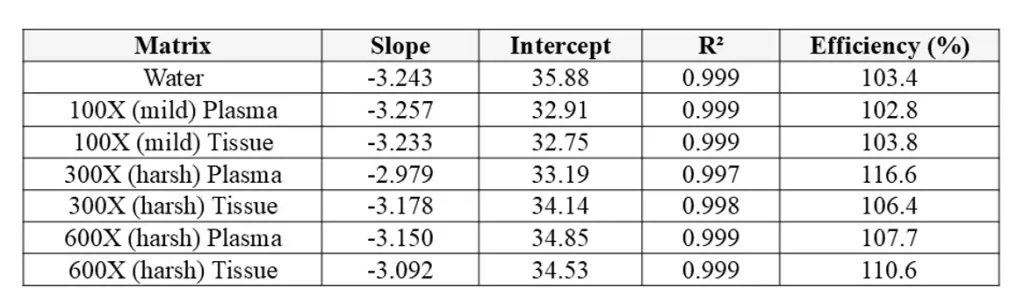
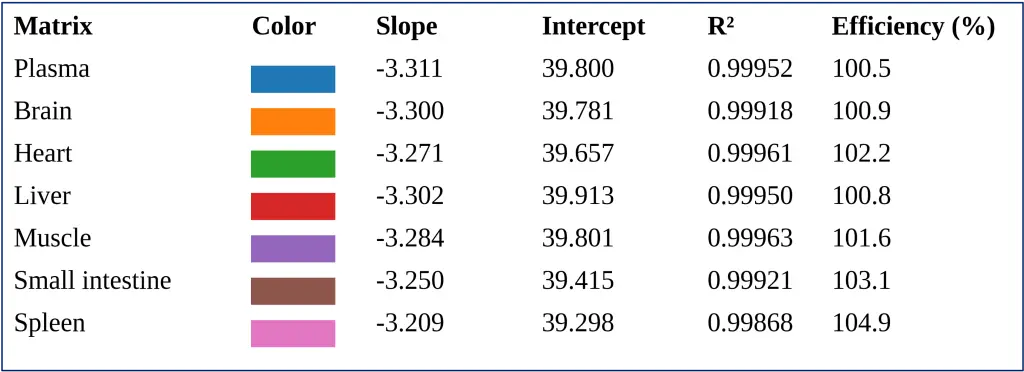
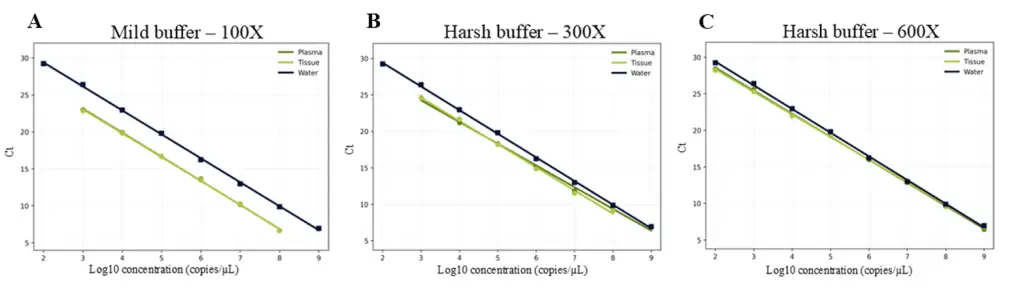
The critical finding came from evaluating dilution ranges across seven biological matrices. At 600x dilution with a harsh detergent buffer, standard curves for plasma and all tissue types converged to near-identical slopes, intercepts, and PCR efficiencies, with R-squared values above 0.998 across all matrices. This meant a single plasma-based standard curve could accurately quantify oligonucleotides across diverse tissues without meaningful loss of accuracy.
Assay performance was confirmed across a broad dynamic range (100 to 10 to the eighth copies per microlitre), using a 75-nucleotide single-stranded DNA target as a model analyte, with QC recoveries consistently falling within the 80-120% acceptance window.
A schematic representing key limitations of traditional qPCR over direct-to-qPCR.
Running Oligonucleotide Studies Across Multiple Matrices?
Resolian’s team has developed and validated extraction-free qPCR workflows for oligonucleotide quantitation across plasma and tissue types, cutting method development time without compromising performance.
The unified workflow delivered several concrete outcomes:
A single common standard curve supports both plasma and six NHP tissue types at 600x dilution
All matrices showed excellent linearity (R-squared above 0.998) and PCR efficiencies near 100%
HQC and LQC recoveries were consistent across matrices, with minimal inter-matrix bias
Hands-on time and per-sample cost were substantially reduced significantly by removing the extraction step
Run-to-run variability was minimized through uniform baseline correction and ROX normalisation
This table shows assay performance summary of respective standard curves.
Standard curve metrics (slope, intercept, R², and efficiency) calculated for each matrix using standards run in 600× diluted matrix backgrounds. All matrices showed excellent linearity (R² > 0.998) and PCR efficiencies near 100%, with minimal slope divergence across matrices.
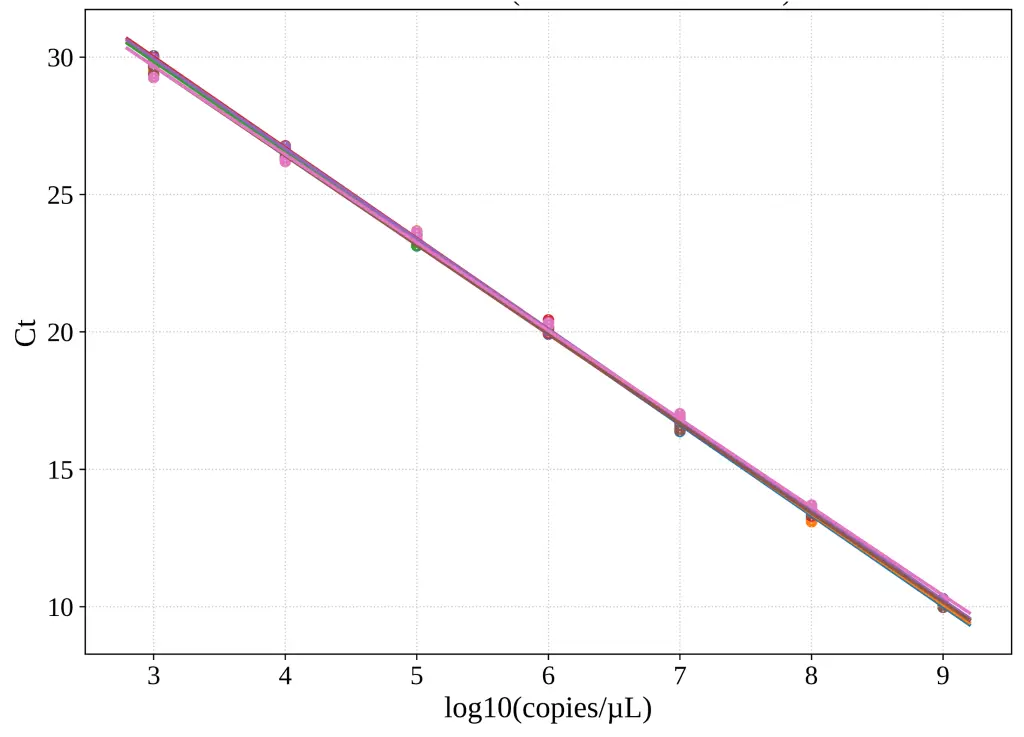
Overlaid standard curves across plasma and tissue matrices. Duplicate Ct values for each matrix are shown as colored points, and corresponding regression lines are displayed in matched colors. Overlaid presentation demonstrates the tight clustering and near parallel behavior of the curves, illustrating that matrix to matrix differences in slope are minimal and that a unified plasma based calibration may be applied without substantial loss of accuracy.
Standard curves generated using 100× mild dilution (A), 300× harsh dilution (B), and 600× harsh dilution (C), showing plasma and tissue linearity across log10 concentrations. Water served as a control matrix. Points indicate measured Ct values (n = 2 per level); lines show least squares fits over the observed range.
What This Means
This work demonstrates that extraction-free qPCR is not a compromise: it is a viable, high-performance approach for multi-matrix oligonucleotide bioanalysis. For sponsors running tissue distribution studies or PK/PD programmes across multiple species, a unified platform means fewer resources spent on method development and more confidence in the data. Resolian is actively expanding this framework to additional tissue types and adapting the approach for one-step RT-qPCR to support RNA quantification.
Resolian partners with pharma and biotech companies to solve complex bioanalytical challenges, enabling faster, more reliable decisions in drug development.
Ready to Simplify Your Oligonucleotide Bioanalysis?
Resolian partners with pharma and biotech companies to deliver high-throughput qPCR and oligonucleotide bioanalytical solutions, from method development through multi-matrix study support.
Zhiyang Zhao, Ph.D., serves as Chief Scientific Officer (CSO) at Resolian. Dr. Zhao has over 30 years of pharmaceutical industry experience with special focus on drug metabolism and bioanalysis of small and large molecules in drug discovery and development. Dr. Zhao has previously held positions at Pfizer, GlaxoSmithKline, and Amgen. Before joining Resolian in 2015, Dr. Zhao served as Site Director of Preclinical Research at Amgen in Cambridge, Massachusetts, for over a decade.
Currently, Dr. Zhao serves as an Adjunct Professor at the Eshelman School of Pharmacy of the University of North Carolina at Chapel Hill, North Carolina, and as Editor-in-Chief of Drug Metabolism & Bioanalysis Letters, a journal by Bentham Science, which publishes in all areas of drug metabolism and bioanalysis. Dr. Zhao received his Ph.D. degree in Medicinal Chemistry from Virginia Polytechnic and State University (popularly known as Virginia Tech) in Blacksburg, Virginia.
Patrick Bennett has over 35 years of experience in pharmaceutical analysis and laboratory management. Now Chief Business Officer at Resolian, Patrick’s experience includes the roles of Strategic Marketing Director for Pharma with Thermo Fisher Scientific, LabCorp, and Vice President of Strategy and Development with PPD.
Patrick earned a B.S. degree in Toxicology and a M.S. degree in Pharmacology from the College of Pharmacy and Allied Health at St. John’s University and an M.B.A in International Marketing from the Martin J. Whitman School of Management at Syracuse University.