
bioanalysis
Authors:
Yan Luo, Danyang Wang, Andy (Hongfang) Xue, Aihua Liu
Background
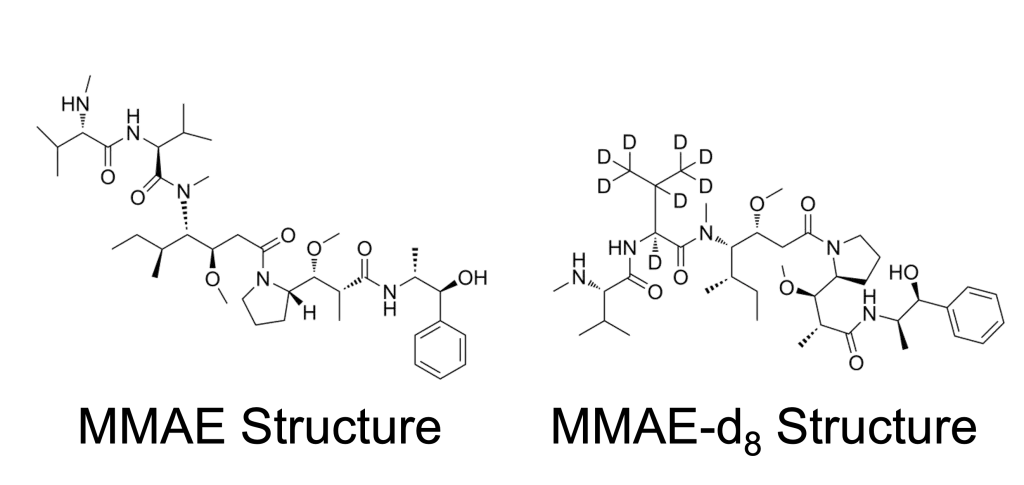
Monomethyl auristatin E (MMAE) is one of the most widely used cytotoxic payloads in antibody-drug conjugate (ADC) therapy.
Its potency is precisely why it is effective: once released from the ADC at the tumour site, it disrupts microtubule polymerisation and induces apoptosis in cancer cells. That same potency makes accurate measurement of free circulating MMAE in clinical plasma samples both clinically important and analytically demanding.
Free MMAE exposure is a key safety pharmacology parameter for ADC programmes, and regulatory expectations for PK characterisation require reliable quantitation at the very low concentrations that result from the small fraction of payload released systemically.
The Challenge
The challenge with MMAE is simple to state and difficult to solve: plasma concentrations of free drug in clinical samples are extremely low, typically in the sub-nanogram per millilitre range, and the matrix is complex.
Standard protein precipitation extraction approaches do not provide sufficient sensitivity or selectivity at these concentration levels.
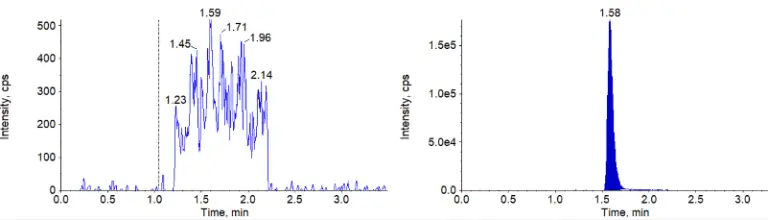
Achieving an LLOQ at or below 1 pg/mL requires a combination of highly selective sample enrichment, chromatographic conditions that resolve MMAE cleanly from matrix interferences, and MS parameters optimised for maximum signal at trace concentrations.
Carryover and interference from ADC-bound MMAE in the same plasma sample add further analytical risk.
Our Approach
Resolian’s team applied the internal method development procedure, a systematic framework that evaluates protein precipitation extraction (PPE) and solid phase extraction (SPE) options in parallel, with defined decision criteria at each stage.
This structured approach identified the optimal extraction strategy without extensive trial-and-error, and the resulting method is directly reproducible across platforms.
Cation exchange SPE was selected as the extraction method based on its ability to achieve the highest sensitivity and cleanest baseline in the comparative evaluation.
The extraction protocol uses formic acid pretreatment to condition the plasma, followed by loading onto a cation exchange cartridge. The critical insight from optimisation was that an acidic loading condition combined with a lower organic concentration wash allowed a strong organic wash step without analyte loss, and basic elution with 50% MeCN or 90% MeOH in 1% ammonium hydroxide achieved maximum analyte recovery.
Extracts were dried under nitrogen and reconstituted before injection onto a pentafluorophenyl (PFP) column, which provides superior retention for the moderately polar MMAE molecule. Detection used a SCIEX Triple Quad 6500+ in positive ion mode, monitoring the 718.6 to 686.6 transition for MMAE and 726.6 to 694.6 for the isotope-labelled internal standard MMAE-d8.
The stability of commercially available ADC in plasma was also assessed: Telisotuzumab vedotin (which uses MMAE as its payload) showed sufficient stability during extraction, with MMAE release at a molar ratio of only 0.02% after 4 hours at room temperature, confirming that ADC-bound payload does not substantially contribute to the free MMAE signal during standard processing.
Need Sub-Picogram Sensitivity for Your ADC Payload?
Resolian’s bioanalytical team has developed and validated ultra-sensitive HPLC-MS/MS methods for free payload quantitation across multiple ADC programs, using the internal framework to identify the optimal extraction strategy fast.
Results
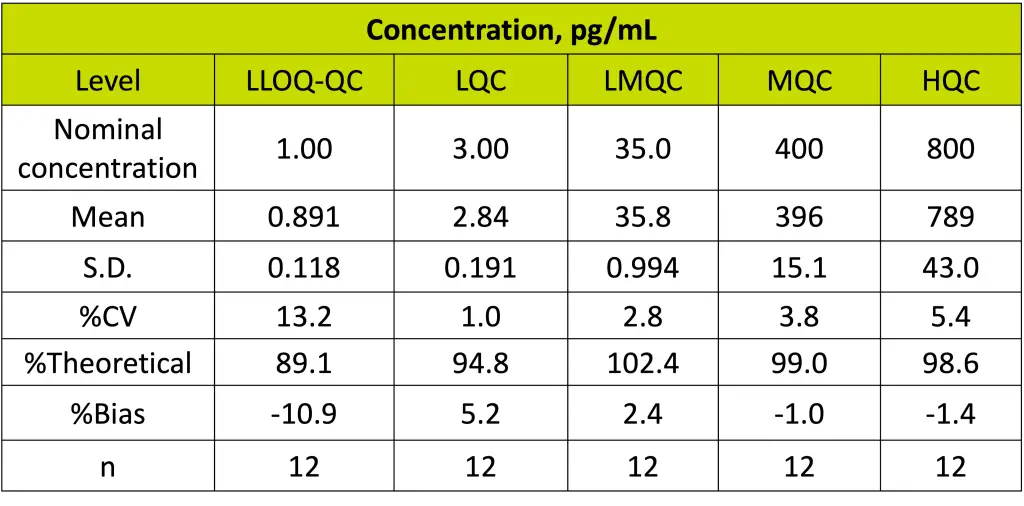
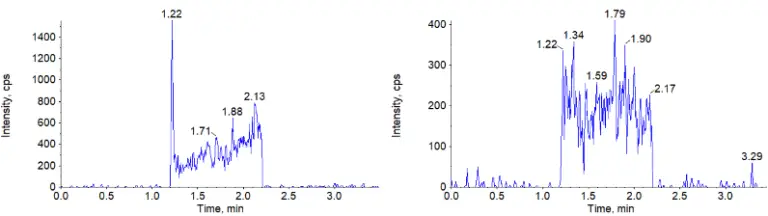
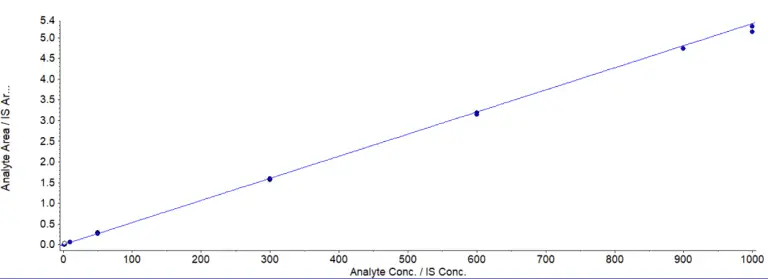
The method was successfully developed and validated across a range of 1.00 to 1,000 pg/mL with the following performance:
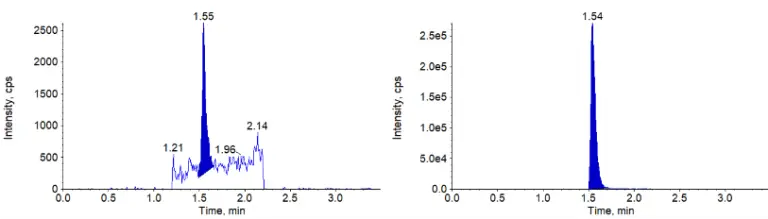
- LLOQ: 1.00 pg/mL, with signal-to-noise ratios confirming adequate sensitivity and no significant interference
- No carryover detected in matrix blank injections following ULOQ samples
- Inter-assay precision: 13.2% CV at LLOQ; 1.0 to 5.4% CV across LQC TO HQC
- Inter-assay accuracy: -10.9% bias at LLOQ; within -1.4 to 5.2% bias across LQC to HQC
- Excellent linearity confirmed using 1/x-squared weighted regression across the full calibration range
- Commercial ADC benchtop stability confirmed: minimal MMAE release during standard extraction procedures
What This Means
A 1 pg/mL LLOQ for free MMAE represents the kind of sensitivity needed to characterise payload exposure in clinical samples where free drug concentrations may be at or near the analytical limit.
For ADC sponsors, having a validated free payload assay at this sensitivity level means PK data is available where it is needed most: at dose levels where exposure is lowest and the safety margin is tightest.
The method development framework that underpins this work is a systematic, transferable approach that Resolian applies across ADC payload assay development, reducing development time and improving first-pass success rates for new programmes.
Resolian partners with pharma and biotech companies to deliver ultra-sensitive bioanalytical methods for ADC payloads and small molecule drugs.
Ready to Characterize Your ADC Payload Exposure?
Resolian partners with pharma and biotech companies to deliver ultra-sensitive bioanalytical methods for ADC payloads and small molecule drugs, from method development through clinical validation.