Resolian developed a hybrid immunocapture nano-LC-MS/MS assay to quantify STAT6, a translational biomarker for RNA-degrading therapeutics, across human tissue types.
bioanalysis
Background
STAT6 is a transcription factor activated downstream of IL-4/IL-13 receptor signaling, driving Th2 immune responses and playing a central role in type 2 inflammation. That makes it both a therapeutic target and a candidate pharmacodynamic biomarker for RNA-degrading therapeutics, including siRNA and antisense oligonucleotides, in development for respiratory and oncology indications. Demonstrating target engagement for these programs means being able to reliably measure STAT6 in human tissue, and that is where the assay challenge begins.
The Challenge
STAT6 is a low-abundance intracellular protein, requiring assay sensitivity in the low-fmol/µL range for reliable detection in tissue. It also belongs to a seven-member STAT family sharing a highly conserved SH2 domain, with STAT5A and STAT5B alone exceeding 90% amino acid sequence identity, creating real risk of antibody cross-reactivity. STAT6 is a large protein, 847 amino acids and roughly 94 kDa, with three reported splice isoforms that further limit antibody epitope options. Commercial STAT6 ELISA kits exist, but remain subject to the cross-reactivity, matrix effects, and reagent dependency inherent to immunoassay-based quantitation.
Our Approach
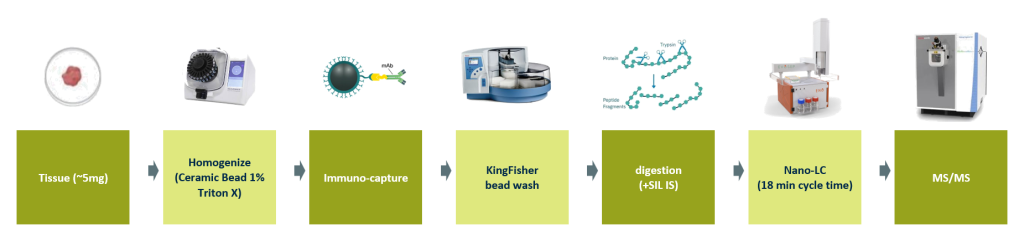
Resolian’s team developed a hybrid immunoaffinity nano-LC-MS/MS assay, combining antibody-based enrichment with targeted mass spectrometric detection of a STAT6-unique tryptic signature peptide. This retains the selectivity of immunoaffinity capture while adding the molecular specificity of LC-MS/MS, eliminating the cross-reactivity risk of immunoassay-only approaches.
Method development identified detergent choice as the primary driver of extraction performance: on-bead digestion consistently outperformed protein elution, and replacing RIPA buffer with 1% Triton X-100 markedly improved analyte signal in both surrogate matrix and human skin homogenate. Extending antibody incubation from 2 hours to overnight at 4 degrees C increased signal approximately 5-fold, and denaturation at 50 degrees C outperformed 60 and 70 degrees C regardless of chemical modifier. Based on these findings, the final method combined 1% Triton X-100 extraction, 50 degrees C denaturation, and overnight 4 degrees C immunocapture, with quantitation by nano-LC-MS/MS following Evotip-based sample cleanup and enrichment.
Hybrid immunoaffinity nano-LC-MS/MS workflow for STAT6 quantitation in human tissue, from homogenization and immunocapture through digestion and detection.
Struggling to Measure a Low-Abundance Protein Biomarker in Tissue?
Resolian’s team pairs immunoaffinity enrichment with targeted nano-LC-MS/MS to deliver the sensitivity and specificity that single-antibody immunoassays can’t.
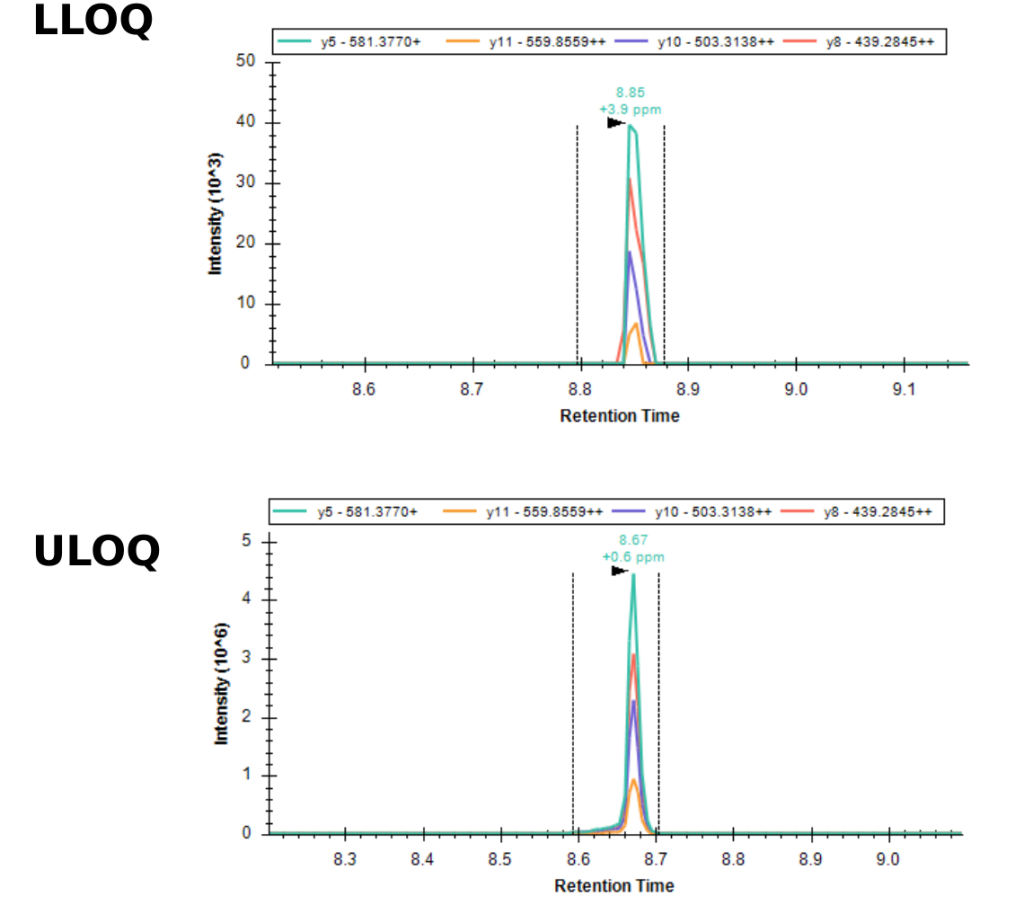
The qualified assay resolved STAT6 across a 100-fold dynamic range, 0.02 to 2.00 fmol/µL, with clean chromatographic peaks at the LLOQ and ULOQ and a linear, 1/x-squared weighted calibration curve (R-squared = 0.9561). Accuracy and precision met predefined acceptance criteria across qualification runs, ranging from 82.5% to 119.1%.
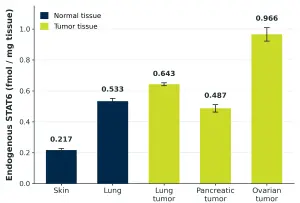
Endogenous STAT6 was quantifiable in all five human tissues tested
Levels ranged from 0.217 fmol/mg in normal skin to 0.966 fmol/mg in ovarian tumor
Tumor tissues generally showed higher STAT6 levels than normal tissue, consistent with a role for STAT6 signaling in tumor biology
Typical chromatograms of STAT6 at the LLOQ (0.02 fmol/µL) and ULOQ (2.00 fmol/µL), showing clean, well-resolved peaks across a 100-fold range.
Endogenous STAT6 levels across five human tissue types, from 0.217 fmol/mg in normal skin to 0.966 fmol/mg in ovarian tumor. Tumor tissue generally showed higher levels than normal.
What This Means
For sponsors developing STAT6-targeted siRNA or ASO programs, this platform provides the pharmacodynamic measurement tool needed to demonstrate target engagement and knockdown directly in tissue. Because the approach is built around immunoaffinity enrichment paired with nano-LC-MS/MS rather than a single-antibody immunoassay, it can be extended to other low-abundance intracellular proteins across RNA-degrading therapeutic programs facing the same specificity and sensitivity constraints.
Ready to Demonstrate Target Engagement for Your siRNA or ASO Program?
Resolian partners with pharma and biotech companies to deliver simple, validated small molecule LC-MS/MS methods for oncology drugs and their active metabolites, from method development through clinical support.
Zhiyang Zhao, Ph.D., serves as Chief Scientific Officer (CSO) at Resolian. Dr. Zhao has over 30 years of pharmaceutical industry experience with special focus on drug metabolism and bioanalysis of small and large molecules in drug discovery and development. Dr. Zhao has previously held positions at Pfizer, GlaxoSmithKline, and Amgen. Before joining Resolian in 2015, Dr. Zhao served as Site Director of Preclinical Research at Amgen in Cambridge, Massachusetts, for over a decade.
Currently, Dr. Zhao serves as an Adjunct Professor at the Eshelman School of Pharmacy of the University of North Carolina at Chapel Hill, North Carolina, and as Editor-in-Chief of Drug Metabolism & Bioanalysis Letters, a journal by Bentham Science, which publishes in all areas of drug metabolism and bioanalysis. Dr. Zhao received his Ph.D. degree in Medicinal Chemistry from Virginia Polytechnic and State University (popularly known as Virginia Tech) in Blacksburg, Virginia.
Patrick Bennett has over 35 years of experience in pharmaceutical analysis and laboratory management. Now Chief Business Officer at Resolian, Patrick’s experience includes the roles of Strategic Marketing Director for Pharma with Thermo Fisher Scientific, LabCorp, and Vice President of Strategy and Development with PPD.
Patrick earned a B.S. degree in Toxicology and a M.S. degree in Pharmacology from the College of Pharmacy and Allied Health at St. John’s University and an M.B.A in International Marketing from the Martin J. Whitman School of Management at Syracuse University.